Pectoral Sandpiper (Calidris melanotos)
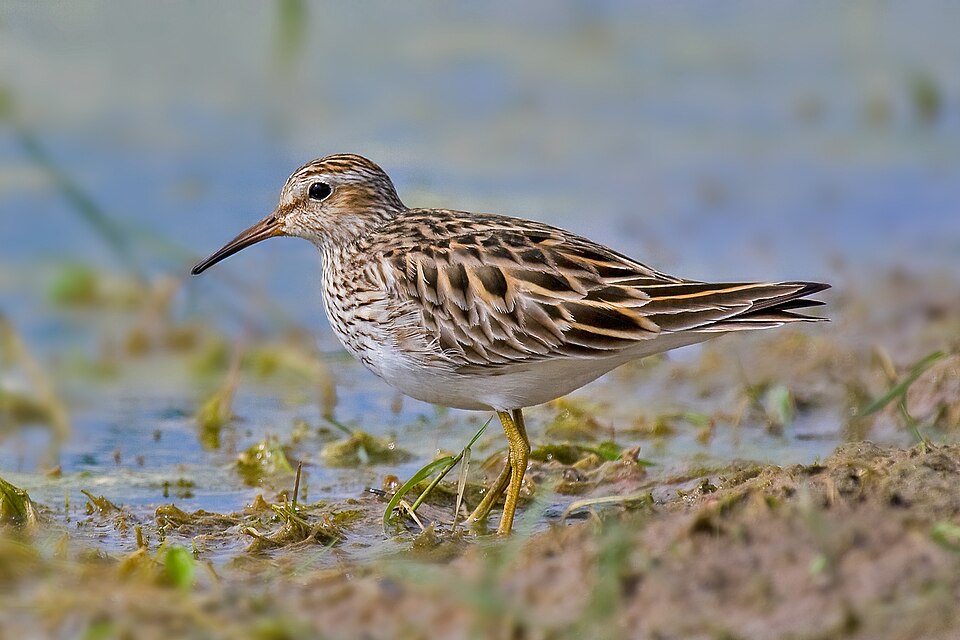
About the Pectoral Sandpiper
The pectoral sandpiper (Calidris melanotos), often abbreviated pec, is a small, migratory wader that breeds in arctic regions of North America and Asia, wintering in South America and Oceania. It eats small invertebrates. Its nest, a hole scraped in the ground and with a thick lining, is deep enough to protect its four eggs from the cool breezes of its breeding grounds. The pectoral sandpiper is 19–23 cm (7.5–9.1 in) long, with a wingspan of 38–46 cm (15–18 in). In the past widely seen as most closely related to sharp-tailed sandpiper, more recent genetic evidence has shown more complex relationships between the species of Calidris, with its closest genetic relatives probably the semipalmated sandpiper and western sandpiper species pair.
A real field recording of the Pectoral Sandpiper. Press play and focus on the rhythm and pitch of each phrase.
Listen
Our streaming copies are mirrored from the original xeno-canto file and transcoded to 96 kbps mono — a modification, so we note it here; the licence for each recording is named in its credit below.
1 recording on this page · licensed CC BY-SA ×1 · mirrored on this server, free for commercial reuse · recorded in Argentina, Belgium, Bolivia, Brazil, Canada, Ecuador and elsewhere · xeno-canto lists 178 recordings for this species in total.
Similar species
- Baird's SandpiperCalidris bairdiirecording
- Broad-billed SandpiperCalidris falcinellusrecording
- Buff-breasted SandpiperCalidris subruficollisprofile
- Curlew SandpiperCalidris ferruginearecording
- DunlinCalidris alpinarecording
- Great KnotCalidris tenuirostrisprofile
Species grouped by shared genus, family and range.