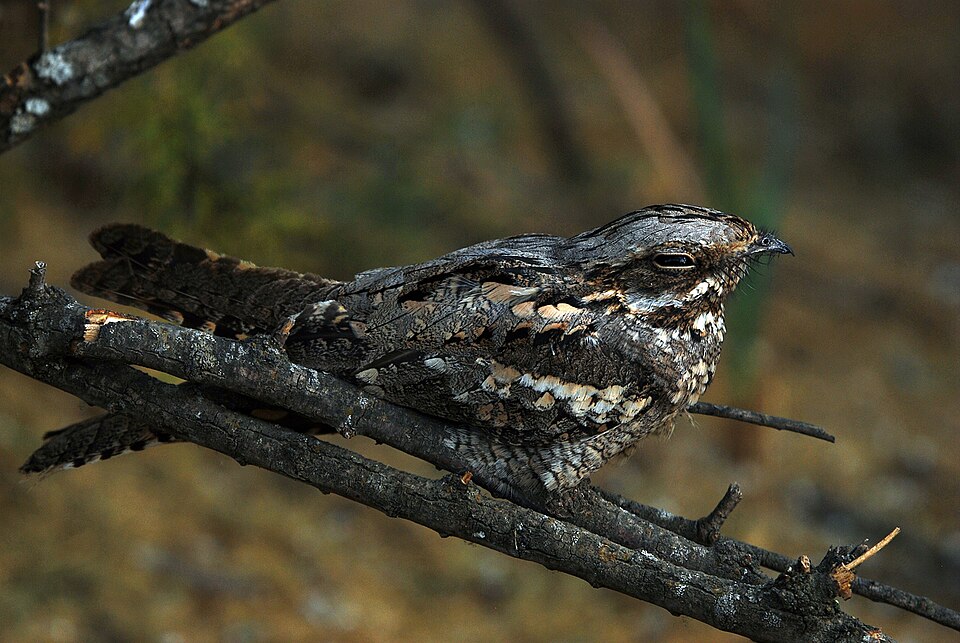
European Nightjar (Caprimulgus europaeus)
Also known asNachtschwalbe · Engoulevent d'Europe · Обыкновенный козодой · Succiacapre · Nachtzwaluw · Noitibó-da-europa · Chotacabras europeo · Europese naguil · Enganyapastors europeu · Lelek lesní
Listen
Our streaming copies are mirrored from the original xeno-canto file and transcoded to 96 kbps mono — a modification, so we note it here; the licence for each recording is named in its credit above.
3 recordings on this page · licensed CC BY ×1 · CC BY-SA ×1 · Public Domain / CC0 ×1 · mirrored on this server, free for commercial reuse · recorded in France, Netherlands, Austria, Belgium, Croatia, Czech Republic and elsewhere · xeno-canto lists 1,946 recordings for this species in total.
A real field recording of the European Nightjar. Press play and focus on the rhythm and pitch of each phrase.
About the European Nightjar
The European nightjar (Caprimulgus europaeus), common goatsucker, Eurasian nightjar or just nightjar is a crepuscular and nocturnal bird in the nightjar family that breeds across most of Europe and the Palearctic to Mongolia and Northwestern China. The Latin generic name refers to the old myth that the nocturnal nightjar suckled from goats, causing them to cease to give milk. The six subspecies differ clinally, the birds becoming smaller and paler towards the east of the range. All populations are migratory, wintering in sub-Saharan Africa. Their densely patterned grey and brown plumage makes individuals difficult to see in the daytime when they rest on the ground or perch motionless along a branch, although the male shows white patches in the wings and tail as he flies at night.
Ecology and behavior
As a member of the Caprimulgidae, this species is associated with open woods, clearings, scrub and dry or sandy country. It typically feeds by hunting flying insects at dawn, dusk and night. That combination of habitat and feeding behavior explains where the bird is easiest to find and why it may be heard more often than seen. Across its range, recorded examples are linked to France, Netherlands. Local habitat can change the exact impression of the voice, but the useful field method stays the same: note the perch, surrounding vegetation, and whether the bird repeats one phrase or gives separate contact sounds.What to listen for
The voice is often a repeated, mechanical or resonant nocturnal phrase; steady repetition is a key clue. The recordings on this page are labeled here as song. Compare each phrase in three passes. First follow the rhythm and repetition. Then judge whether the tone is clear, burry, buzzy, rounded or harsh. Finally notice the pitch direction and the spacing between statements. These three features are more reliable than trying to translate the sound into words alone. A useful field note should describe the whole phrase before naming the bird. For this species, write whether the sound stays level, rises or falls, how long each series lasts, and whether the bird seems exposed, hidden in cover, or associated with a particular edge between habitats. Those details make the recording transferable to a real outdoor encounter.A field note on this voice
When you are most likely to hear this voice
The recordings featured here were made in May, July. Those months may offer a useful seasonal clue, but vocal activity can vary widely across regions and years. Weather, latitude, food availability and local breeding cycles may all influence when a bird chooses to sing. Think of the timing as a starting point rather than a rule. The examples on this page come from recordings made in France, Netherlands. In the field, behavior and habitat often provide stronger evidence than the calendar alone.
Time of day
These particular recordings were made later in the day, usually around 22:00. Many birds are especially vocal in the early hours, when sound may carry well and singing can be a regular part of the morning. Birds may also vocalize later in the day while feeding, moving between perches, interacting with nearby individuals or responding to changes around them. Listening conditions can change how a sound is perceived. Returning to the same recording at different times and imagining the surrounding cover, light and weather can make the context easier to hear.
What this vocalization may suggest
This page contains a song rather than a simple call. Songs are often longer, more structured and more repetitive than short calls. A clear phrase repeated at regular intervals can be associated with breeding activity or the defense of space, although the exact context is best confirmed by observation. Shorter notes may accompany movement, alertness or contact with nearby birds. Faster, louder or harsher delivery can sometimes reflect heightened interaction, while an evenly spaced performance may simply be routine. Notice the surrounding behavior before deciding what the sound might mean.
Understanding pitch
High notes do not automatically indicate courtship, and low notes do not necessarily signal alarm. Pitch works alongside rhythm, repetition, volume and tone. A high, clear phrase may be a territorial song, while high, irregular notes might suggest agitation; some low, soft sounds may simply help birds stay in contact. Rather than focusing on pitch alone, observe what the bird is doing before and after the sound. The most useful field note combines the voice with place, time and behavior.
Editor's note
These interpretations are intended as listening guidance based on the available recordings and context, not as proof of an individual bird's intent. Strong observations note the date and time, habitat, perch height, weather and behavior before and after the vocalization.
Similar species
- Indian NightjarCaprimulgus asiaticusrecording
- Jerdon's NightjarCaprimulgus atripennisrecording
- Large-tailed NightjarCaprimulgus macrurusrecording
- Red-necked NightjarCaprimulgus ruficollisrecording
- Andaman NightjarCaprimulgus andamanicusprofile
- Bates's NightjarCaprimulgus batesiprofile
- Black-shouldered NightjarCaprimulgus nigriscapularisprofile
- Bonaparte's NightjarCaprimulgus concretusprofile
- Donaldson Smith's NightjarCaprimulgus donaldsoniprofile
- Egyptian NightjarCaprimulgus aegyptiusprofile
Species grouped by shared genus, family and range. Family: Caprimulgidae.
More birds recorded in France
- Red-rumped SwallowCecropis dauricarecording
- Red-throated LoonGavia stellatarecording
- Red-throated PipitAnthus cervinusrecording
- Red-whiskered BulbulPycnonotus jocosusrecording
- RedwingTurdus iliacusrecording
- Reeves's PheasantSyrmaticus reevesiirecording
- Reunion StonechatSaxicola tectesrecording
- Richard's PipitAnthus richardirecording
Every species xeno-canto lists for this country is on the full France list — 628 species, the ones with recordings marked ▶.