Crested Caracara (Caracara plancus)
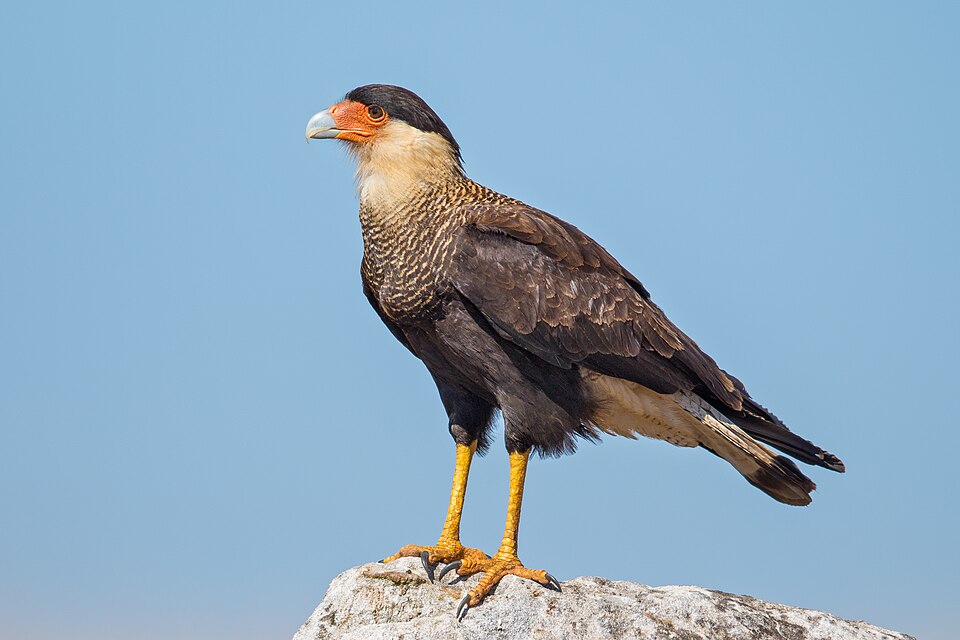
About the Crested Caracara
The crested caracara (Caracara plancus) is a bird of prey (raptor) in the falcon family, Falconidae. It was formerly placed in the genus Polyborus before being given in its own genus, Caracara. It is native to and found in the southern and southeastern United States, Mexico (where it is present in every state) and the majority of mainland Latin America, as well as some Caribbean islands. The crested caracara is quite adaptable and hardy, for a species found predominantly in the neotropics; it can be found in a range of environments and ecosystems, including semi-arid and desert climates, maritime or coastal areas, subtropical and tropical forests, temperate regions, plains, swamps, and even in urban areas. Documented, albeit rare, sightings have occurred as far north as Minnesota and the Canadian provinces of Alberta, Ontario, and Prince Edward Island. The southern extent of the crested caracara's distribution can reach as far as Tierra del Fuego and Magallanes Region, Chile.
A real field recording of the Crested Caracara. Press play and focus on the rhythm and pitch of each phrase.
Listen
Our streaming copies are mirrored from the original xeno-canto file and transcoded to 96 kbps mono — a modification, so we note it here; the licence for each recording is named in its credit below.
1 recording on this page · licensed CC BY-SA ×1 · mirrored on this server, free for commercial reuse · recorded in Argentina, Bolivia, Brazil, Chile, Colombia, Costa Rica and elsewhere · xeno-canto lists 193 recordings for this species in total.
Other birds in this region
- American Barn OwlTyto furcatarecording
- American KestrelFalco sparveriusrecording
- Baird's SandpiperCalidris bairdiirecording
- Band-winged NightjarSystellura longirostrisrecording
- Barn SwallowHirundo rusticarecording
- Black-crowned Night HeronNycticorax nycticoraxrecording
These are the birds recorded alongside it, not close relatives — the site holds no other member of its genus or family yet.