Golden Pheasant (Chrysolophus pictus)
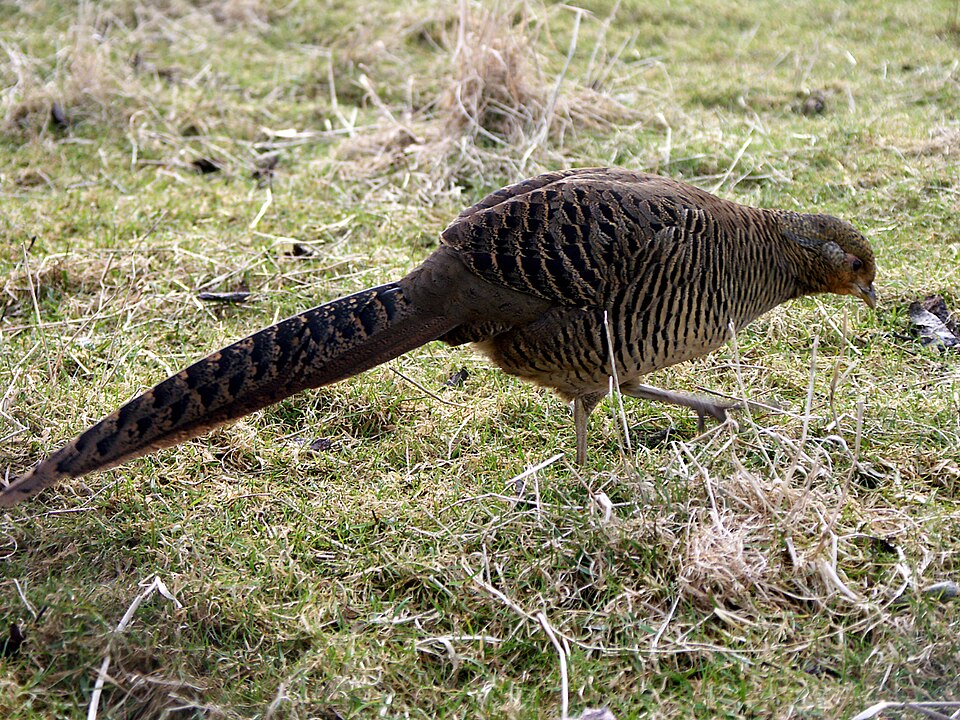
About the Golden Pheasant
The golden pheasant (Chrysolophus pictus), also known as the Chinese pheasant, and rainbow pheasant, is a gamebird of the order Galliformes (gallinaceous birds) and the family Phasianidae (pheasants). The genus name is from Ancient Greek khrusolophos, "with golden crest", and pictus is Latin for "painted" from pingere, "to paint". The golden pheasant was formally described in 1758 by the Swedish naturalist Carl Linnaeus in the tenth edition of his Systema Naturae under the binomial name Phasianus pictus. He specified the type location as China. The specific epithet pictus is Latin meaning "painted". The golden pheasant is now placed with Lady Amherst's pheasant in the genus Chrysolophus that was introduced in 1834 by the English zoologist John Edward Gray.
No audio on this page yet
We only publish recordings we may use commercially, because this site is supported by ads. xeno-canto lists 30 recordings for this species: 18 CC BY-NC-SA · 5 CC BY-NC-ND. None of them permits commercial use, so there is no player here — the page is kept as a profile so the bird is not missing from the guide.
As soon as someone uploads a freely licensed recording, we mirror it and the player appears here.
Listed as recorded in China, Denmark, France, Russia in the xeno-canto catalogue.
Other birds you can hear here
- Bar-tailed GodwitLimosa lapponicarecording
- Barn SwallowHirundo rusticarecording
- Bearded ReedlingPanurus biarmicusrecording
- Black RedstartPhoenicurus ochrurosrecording
- Black WoodpeckerDryocopus martiusrecording
- Black-crowned Night HeronNycticorax nycticoraxrecording
These are the birds recorded alongside it, not close relatives — the site holds no other member of its genus or family yet.