Black-legged Seriema (Chunga burmeisteri)
About the Black-legged Seriema
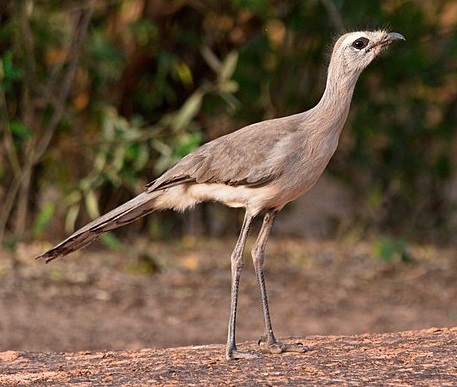
The black-legged seriema (Chunga burmeisteri) is one of two living species of seriemas in the family Cariamidae. It is found from southeastern Bolivia and northern Paraguay south into north-central Argentina. It is a large, mostly grey bird with a long neck, a long tail, and long, slender black legs. Its belly, vent and thighs are yellowish-white. The sexes look similar, as do immature birds, though the latter are more patterned on head, neck and back. First described for science by Gustav Hartlaub in 1860, it is monotypic, with no subspecies. Like its red-legged cousin, it is an omnivore. It seldom flies, instead pursuing prey and eluding danger on foot. Its loud calls, said to sound like kookaburras, turkeys or yelping dogs, are often given in duet. Little is known about its breeding ecology. It is known to breed in November and December, building a platform nest of sticks and laying two white eggs, which are sometimes marked with a few brownish or purple spots. The International Union for Conservation of Nature rates the species as one of least concern, due to its large range and apparently stable numbers.
No audio on this page yet
We only publish recordings we may use commercially, because this site is supported by ads. xeno-canto lists 32 recordings for this species: 16 CC BY-NC-ND · 9 CC BY-NC-SA. None of them permits commercial use, so there is no player here — the page is kept as a profile so the bird is not missing from the guide.
As soon as someone uploads a freely licensed recording, we mirror it and the player appears here.
Listed as recorded in Argentina, Bolivia, Paraguay in the xeno-canto catalogue.
Other birds you can hear here
- American Barn OwlTyto furcatarecording
- Andean Slaty ThrushTurdus nigricepsrecording
- Ash-throated CrakeMustelirallus albicollisrecording
- BananaquitCoereba flaveolarecording
- Barred AntshrikeThamnophilus doliatusrecording
- Barred Forest FalconMicrastur ruficollisrecording
These are the birds recorded alongside it, not close relatives — the site holds no other member of its genus or family yet.