Black Vulture (Coragyps atratus)
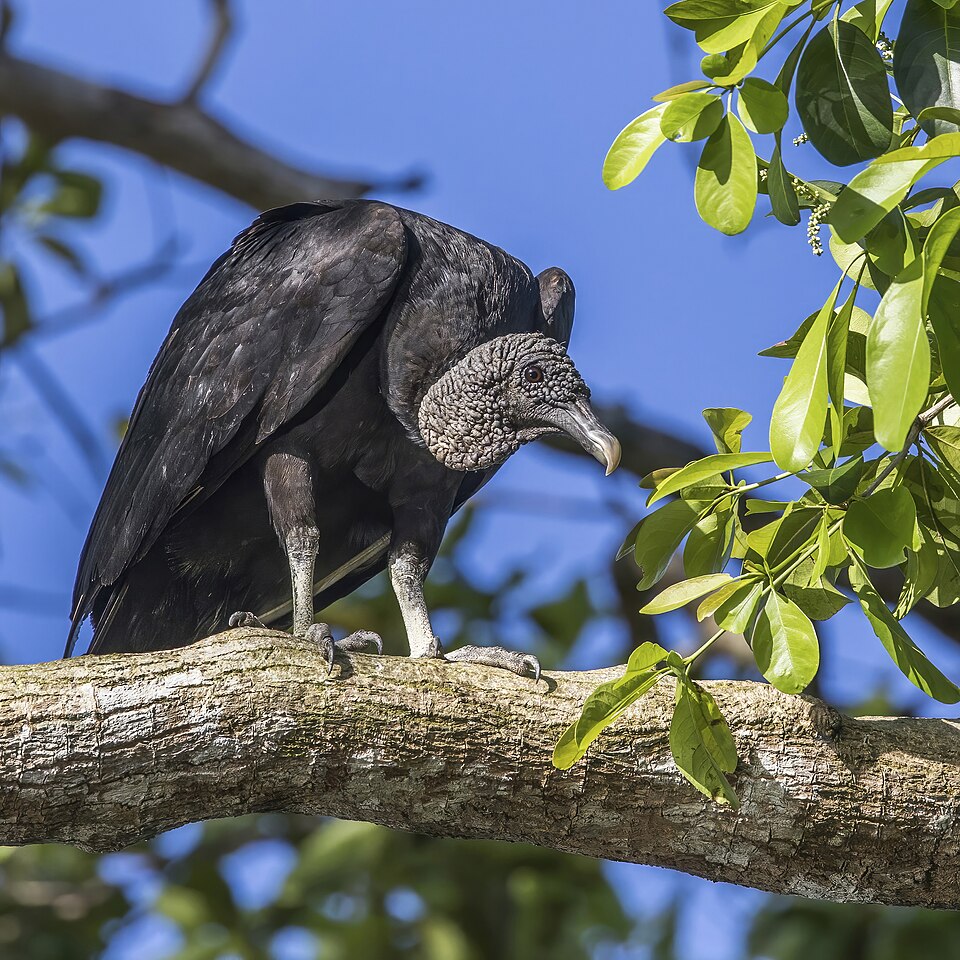
About the Black Vulture
The black vulture (Coragyps atratus), also known as the American black vulture, Mexican vulture, zopilote, urubu, or gallinazo, is a bird in the New World vulture family whose range extends from the northeastern United States to Peru, Central Chile and Uruguay in South America, and common throughout Brazil where it can be seen in large scavenging groups. Although a common and widespread species, it has a somewhat more restricted distribution than its compatriot, the turkey vulture, which breeds well into Canada and all the way south to Tierra del Fuego. It is the only extant member of the genus Coragyps, which is in the family Cathartidae. Despite the similar name and appearance, this species is not closely related to the Eurasian black vulture, an Old World vulture, of the family Accipitridae (which includes raptors like the eagles, hawks, kites, and harriers). For ease of locating animal corpses (their primary source of sustenance), black vultures tend to inhabit relatively open areas with scattered trees, such as chaparral, in addition to subtropical forested areas and parts of the Brazilian pantanal.
No audio on this page yet
We only publish recordings we may use commercially, because this site is supported by ads. xeno-canto lists 73 recordings for this species: 2 CC BY-NC-ND · 1 CC BY-NC-SA. None of them permits commercial use, so there is no player here — the page is kept as a profile so the bird is not missing from the guide.
As soon as someone uploads a freely licensed recording, we mirror it and the player appears here.
Listed as recorded in Argentina, Brazil, Chile, Colombia in the xeno-canto catalogue.
Other birds you can hear here
- American Barn OwlTyto furcatarecording
- American KestrelFalco sparveriusrecording
- Band-winged NightjarSystellura longirostrisrecording
- Barn SwallowHirundo rusticarecording
- American Cliff SwallowPetrochelidon pyrrhonotarecording
- American Golden PloverPluvialis dominicarecording
These are the birds recorded alongside it, not close relatives — the site holds no other member of its genus or family yet.