Australian Raven (Corvus coronoides)
About the Australian Raven
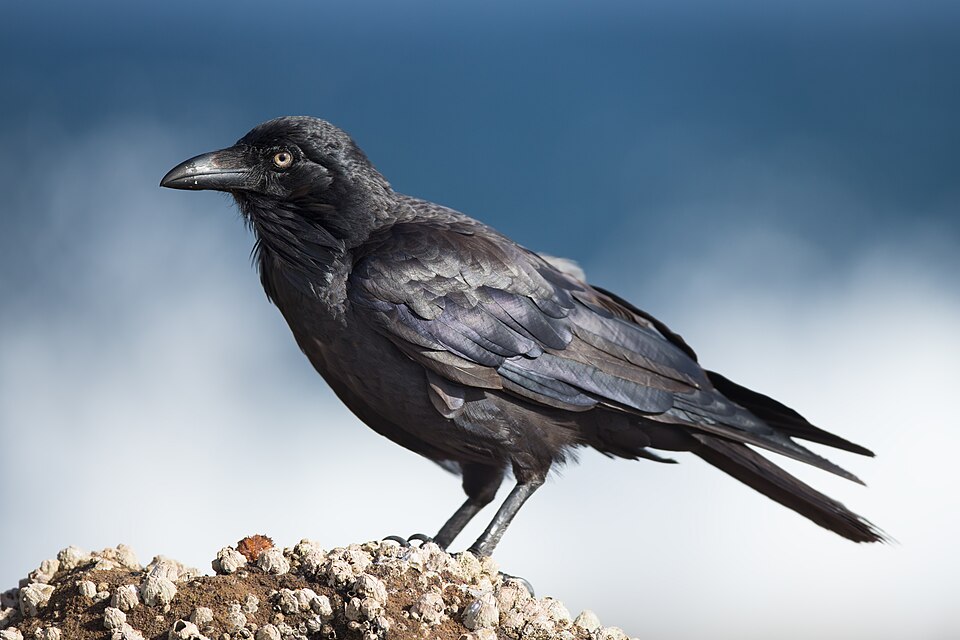
The Australian raven (Corvus coronoides) is a passerine corvid bird native to Australia. Measuring 46–53 centimetres (18–21 in) in length, it has an all-black plumage, beak and mouth, as well as strong, greyish-black legs and feet. The upperparts of its body are glossy, with a purple-blue, greenish sheen; its black feathers have grey bases. The Australian raven is distinguished from the Australian crow, and other related corvids, by its long chest feathers, or throat hackles, which are prominent in mature birds. Older individuals and subadults have white irises, while the younger birds' eyes display blue inner rims; hatchlings and young birds have brown, dark irises until about fifteen months of age, at which point their irises become hazel-coloured, with an inner blue rim around each pupil, this lasting until they are roughly 2.5 to 3 years of age. Nicholas Aylward Vigors and Thomas Horsfield described the Australian raven in 1827, its species name coronoides highlighting its similarity with the carrion crow (C. corone). Two subspecies are recognised, which differ slightly in their vocalisations, and are quite divergent, genetically.
No audio on this page yet
We only publish recordings we may use commercially, because this site is supported by ads. xeno-canto lists 57 recordings for this species: 39 CC BY-NC-ND · 18 CC BY-NC-SA. None of them permits commercial use, so there is no player here — the page is kept as a profile so the bird is not missing from the guide.
As soon as someone uploads a freely licensed recording, we mirror it and the player appears here.
Listed as recorded in Australia in the xeno-canto catalogue.
Related species you can hear
- American CrowCorvus brachyrhynchosrecording
- Carrion CrowCorvus coronerecording
- Fish CrowCorvus ossifragusrecording
- Flores CrowCorvus florensisrecording
- Hooded CrowCorvus cornixrecording
- House CrowCorvus splendensrecording
This species has no recording here yet — these relatives do, so you can hear what the family sounds like.