Great Blue Turaco (Corythaeola cristata)
Also known asTouraco géant · Riesenturako · 藍蕉鵑 · カンムリエボシドリ · موزخوار آبی بزرگ · Большой голубой турако · Reuzentoerako · Turac gegant · Turako velký · Kæmpeturako
Listen
Our streaming copies are mirrored from the original xeno-canto file and transcoded to 96 kbps mono — a modification, so we note it here; the licence for each recording is named in its credit above.
1 recording on this page · licensed CC BY-SA ×1 · mirrored on this server, free for commercial reuse · recorded in Tanzania, Cameroon, Gabon, Ghana, Kenya, Uganda · xeno-canto lists 64 recordings for this species in total.
A real field recording of the Great Blue Turaco. Press play and focus on the rhythm and pitch of each phrase.
About the Great Blue Turaco
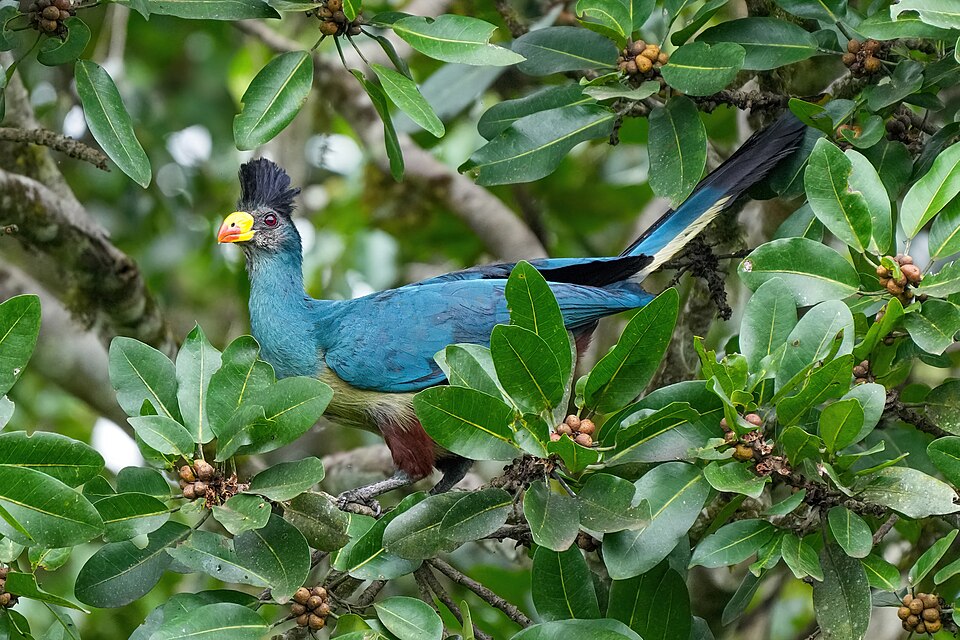
The great blue turaco (Corythaeola cristata) is a bird species of the family Musophagidae. At 70–76 cm (28–30 in) in length, it is the largest species of turaco. It has predominantly grey-blue plumage with an upright blue-black crest around 10 cm (3.9 in) high. The male and female have similar plumage. It is widespread throughout the African tropical rainforest. French ornithologist Louis Pierre Vieillot described the great blue turaco as Musophaga cristata in 1816, before German ornithologist Ferdinand Heine placed it in its own genus in 1860.
Ecology and behavior
As a member of Musophagidae, this bird is associated with the habitats typical of this family, including forest edges, open growth, wetlands or dense cover. It generally feeds by food resources appropriate to its size and bill type. These habits determine where the bird is easiest to observe and explain why a recording often gives the first clue to its presence. Recorded examples on this site are linked to Tanzania. Local vegetation and weather can change the impression of the voice, but field identification still depends on the same evidence: the perch, surrounding cover and behavior of the calling bird.What to listen for
Listen first for rhythm, then tone, then pitch direction and spacing. The available recordings are labeled as call. On the first listen, follow repetition and phrase length. On the second, decide whether the tone is clear, buzzy, burry, harsh, rounded or thin. On the third, trace pitch direction and the gaps between phrases. A strong field note describes the complete sound before naming the species. Note whether the bird stays hidden or uses an exposed perch, whether phrases accelerate, and whether the voice belongs to a boundary between two habitats. Those details make the recording useful during a real encounter. Replaying the recording after a short break also helps; familiar rhythm is easier to recognize than an isolated note. Compare the recording with the habitat immediately around you: the same phrase heard from dense cover, an exposed branch or an open edge can point toward different behavior. Returning to the phrase after a short pause makes the rhythm easier to remember and helps transfer the recording to field use.A field note on this voice
Listening context
The recordings shown here come from Tanzania. Because exact recording dates are not available for this conservative note, it is best not to treat any month or season as guaranteed. Local weather, latitude, habitat and breeding cycles can all change when a bird is most vocal. Use the region as a starting point, then look for supporting evidence in the field. Habitat, perch height, light conditions and observed behavior often provide more reliable context than a broad seasonal guess.
Time of day
The exact recording time is not available for this sample. Early morning is often a productive time to listen because many birds sing more regularly then and sound may carry well, but that is a general observation rather than a rule for this species. Birds may also vocalize later while feeding, moving through cover, interacting with nearby individuals or responding to disturbance. Listen for the same kinds of sounds at different times and compare the surrounding behavior.
What this vocalization may suggest
This page contains call. Songs are often longer, more structured and more repetitive than short calls. A clear phrase repeated at regular intervals can be associated with breeding activity or the defense of space, although the exact meaning should be confirmed by observation. Shorter or more abrupt notes may accompany movement, alertness or contact between birds. Changes in pace, volume or tone can sometimes reflect heightened interaction, while an evenly spaced delivery may simply be routine.
Understanding pitch
High notes do not automatically indicate courtship, and low notes do not necessarily signal alarm. Pitch works alongside rhythm, repetition, volume and tone. A high, clear phrase may be a territorial song, while high, irregular notes might suggest agitation; some low, soft sounds may simply help birds stay in contact. Rather than focusing on pitch alone, observe what the bird is doing before and after the sound. The most useful field note combines the voice with place, habitat, time and behavior.
Editor's note
These interpretations are intended as listening guidance based on the available recordings and context, not as proof of an individual bird's intent. When exact dates or times are unavailable, this note deliberately avoids claiming them. Strong observations record the date and time, habitat, perch height, weather and behavior before and after the vocalization.
Other birds in this region
- African Wood OwlStrix woodfordiirecording
- Bronze MannikinSpermestes cucullatarecording
- Brown IlladopsisIlladopsis fulvescensrecording
- Collared SunbirdHedydipna collarisrecording
- Dusky Long-tailed CuckooCercococcyx mechowirecording
- African CuckooCuculus gularisrecording
- African Pied WagtailMotacilla aguimprecording
- Black-crowned TchagraTchagra senegalusrecording
- Black-faced Rufous WarblerBathmocercus rufusrecording
- Blue-shouldered Robin-ChatCossypha cyanocampterrecording
These are the birds recorded alongside it, not close relatives — the site holds no other member of its genus or family yet. Family: Musophagidae.
More birds recorded in Tanzania
- Lesser Striped SwallowCecropis abyssinicarecording
- Little EgretEgretta garzettarecording
- Little GrebeTachybaptus ruficollisrecording
- Little GreenbulEurillas virensrecording
- Little Rock ThrushMonticola rufocinereusrecording
- Little Rush WarblerBradypterus baboecalarecording
- Little StintCalidris minutarecording
- Long-billed Forest WarblerArtisornis moreauirecording
Every species xeno-canto lists for this country is on the full Tanzania list — 659 species, the ones with recordings marked ▶.