Black-sided Flowerpecker (Dicaeum monticolum)
About the Black-sided Flowerpecker
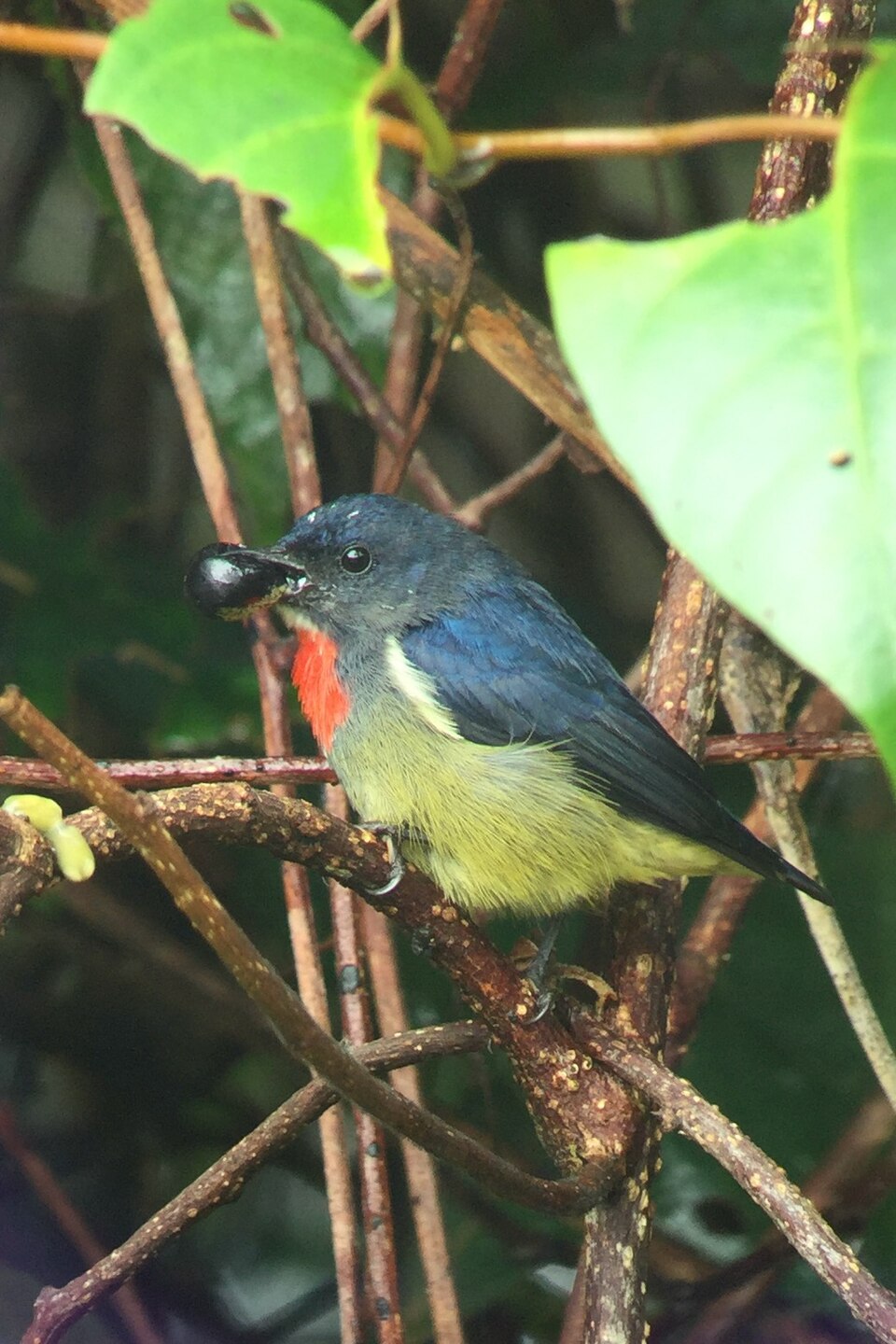
The black-sided flowerpecker (Dicaeum monticolum), also known as the Bornean flowerpecker, is a species of bird in the family Dicaeidae. It is endemic to the island of Borneo, where it is found in the mountains, primarily above 1,000 m (3,300 ft) in elevation. The species is sexually dimorphic. The male has glossy blue-black upperparts, with a scarlet throat and breast, a dark grey upper belly, olive flanks, a white lower belly, and a buffy vent and undertail coverts. The female is olive-green above and greyish below, with buffy flanks and a whitish throat. It inhabits a range of forest habitats, including primary and secondary montane forest, kerangas forest, and scrub, and is also occasionally found in gardens. It feeds primarily on small fruits—particularly mistletoe berries—as well as seeds, nectar, and various invertebrates. It builds a nest of moss, camouflaged on the outside with lichens and lined with the pith of tree ferns. The International Union for Conservation of Nature rates it as a species of least concern. Though its numbers have not been quantified, the black-sided flowerpecker is said to be common throughout much of its range, and any declines are not thought to be precipitous. However, destruction of forest for palm plantations may impact it.
No audio on this page yet
We only publish recordings we may use commercially, because this site is supported by ads. xeno-canto lists 11 recordings for this species: 2 CC BY-NC-SA. None of them permits commercial use, so there is no player here — the page is kept as a profile so the bird is not missing from the guide.
As soon as someone uploads a freely licensed recording, we mirror it and the player appears here.
Listed as recorded in Indonesia, Malaysia in the xeno-canto catalogue.
Related species you can hear
- Black-fronted FlowerpeckerDicaeum igniferumrecording
- Blood-breasted FlowerpeckerDicaeum sanguinolentumrecording
- MistletoebirdDicaeum hirundinaceumrecording
- Pale-billed FlowerpeckerDicaeum erythrorhynchosrecording
This species has no recording here yet — these relatives do, so you can hear what the family sounds like.