Red-shouldered Macaw (Diopsittaca nobilis)
About the Red-shouldered Macaw
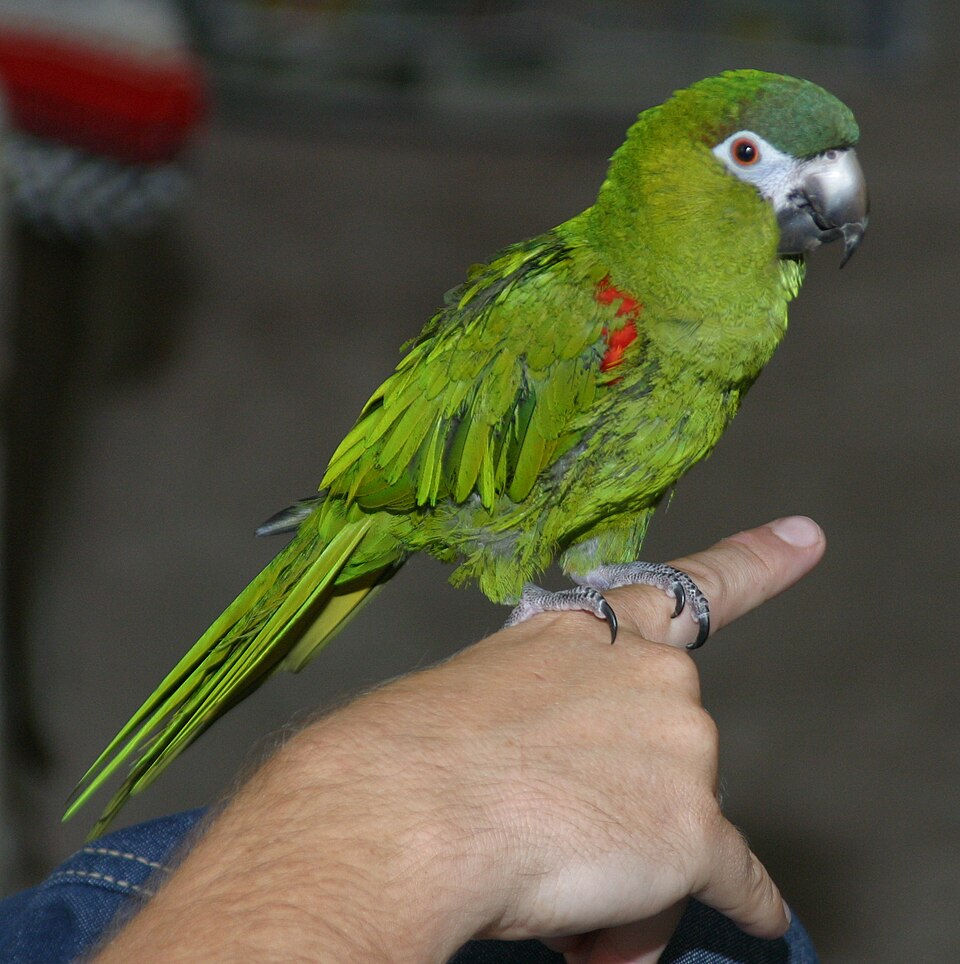
The red-shouldered macaw (Diopsittaca nobilis) is a small green South American parrot, a member of a large group of Neotropical parrots called macaws. The species is named for the red coverts on its wings. It is the smallest macaw, being 30 cm (12 in) in length – similar in size to the Aratinga parakeets. It is native to the tropical lowlands, savannahs, and swamplands of Brazil, the Guianas, Bolivia, Venezuela, and far south-eastern Peru. There are three subspecies: The noble macaw (Diopsittaca nobilis cumanensis), Hahn's macaw (Diopsittaca nobilis nobilis), and the long-winged macaw (Diopsittaca nobilis longipennis). The long-winged macaw is a poorly distinct third subspecies that has longer wings, but is otherwise similar to the noble macaw. The Hahn's subspecies is named for German zoologist Carl-Wilhelm Hahn, who in 1834 began compiling Ornithologischer Atlas oder naturgetreue Abbildung und Beschreibung der aussereuropäischen Vögel (Engl: Ornithological Atlas or natural depiction and description of birds from outside Europe).
No audio on this page yet
We only publish recordings we may use commercially, because this site is supported by ads. xeno-canto lists 127 recordings for this species: 4 CC BY-NC-SA. None of them permits commercial use, so there is no player here — the page is kept as a profile so the bird is not missing from the guide.
As soon as someone uploads a freely licensed recording, we mirror it and the player appears here.
Listed as recorded in Bolivia, Brazil, Peru, Venezuela in the xeno-canto catalogue.
Other birds you can hear here
- Amazonian Barred WoodcreeperDendrocolaptes certhiarecording
- Amazonian GrosbeakCyanoloxia rothschildiirecording
- American Barn OwlTyto furcatarecording
- BananaquitCoereba flaveolarecording
- Band-winged NightjarSystellura longirostrisrecording
- Barred AntshrikeThamnophilus doliatusrecording
These are the birds recorded alongside it, not close relatives — the site holds no other member of its genus or family yet.