Great Stone-curlew (Esacus recurvirostris)
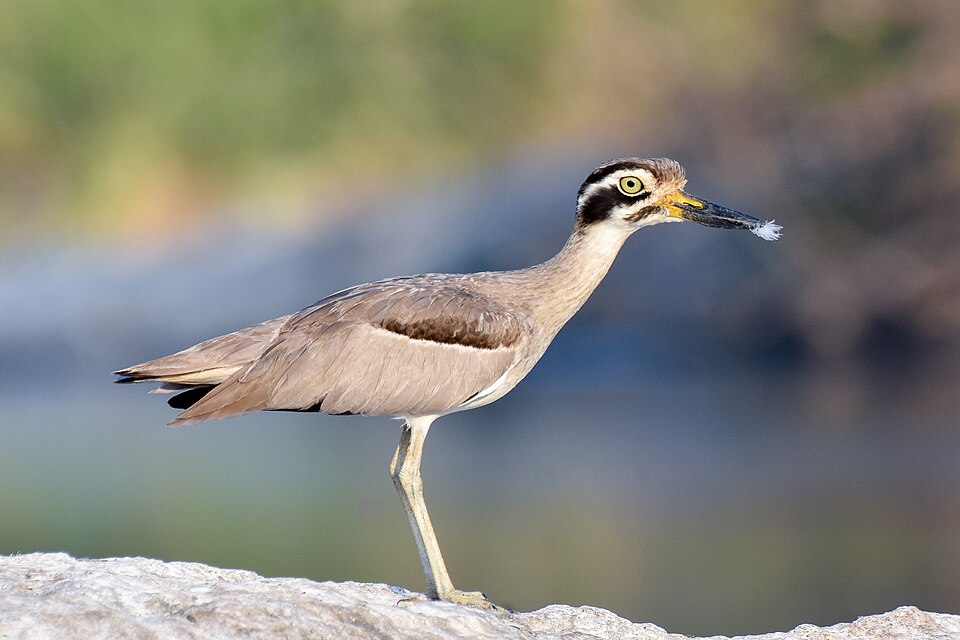
About the Great Stone-curlew
The great stone-curlew or great thick-knee (Esacus recurvirostris) is a large wader which is a resident breeder in tropical southern Asia from India, Pakistan, Sri Lanka, Bangladesh into South-east Asia. The great stone-curlew was formally described in 1829 by the French naturalist Georges Cuvier and given the binomial name Oedicnemus recurvirostris. The type locality is Nepal. The specific epithet recurvirostris combines Latin recurvis meaning "bent backwards" with -rostris meaning "-billed". The species is now placed in the genus Esacus that was introduced in 1831 to accommodate the great stone-curlew by the French naturalist René Lesson. The species is monotypic: no subspecies are recognised.
No audio on this page yet
We only publish recordings we may use commercially, because this site is supported by ads. xeno-canto lists 30 recordings for this species: 18 CC BY-NC-ND · 4 CC BY-NC-SA. None of them permits commercial use, so there is no player here — the page is kept as a profile so the bird is not missing from the guide.
As soon as someone uploads a freely licensed recording, we mirror it and the player appears here.
Listed as recorded in India, Sri Lanka, Thailand, Vietnam in the xeno-canto catalogue.
Other birds you can hear here
- Ashy WoodswallowArtamus fuscusrecording
- Asian Green Bee-eaterMerops orientalisrecording
- Asian KoelEudynamys scolopaceusrecording
- Asian Palm SwiftCypsiurus balasiensisrecording
- Banded Bay CuckooCacomantis sonneratiirecording
- Black-hooded OrioleOriolus xanthornusrecording
These are the birds recorded alongside it, not close relatives — the site holds no other member of its genus or family yet.