American White Ibis (Eudocimus albus)
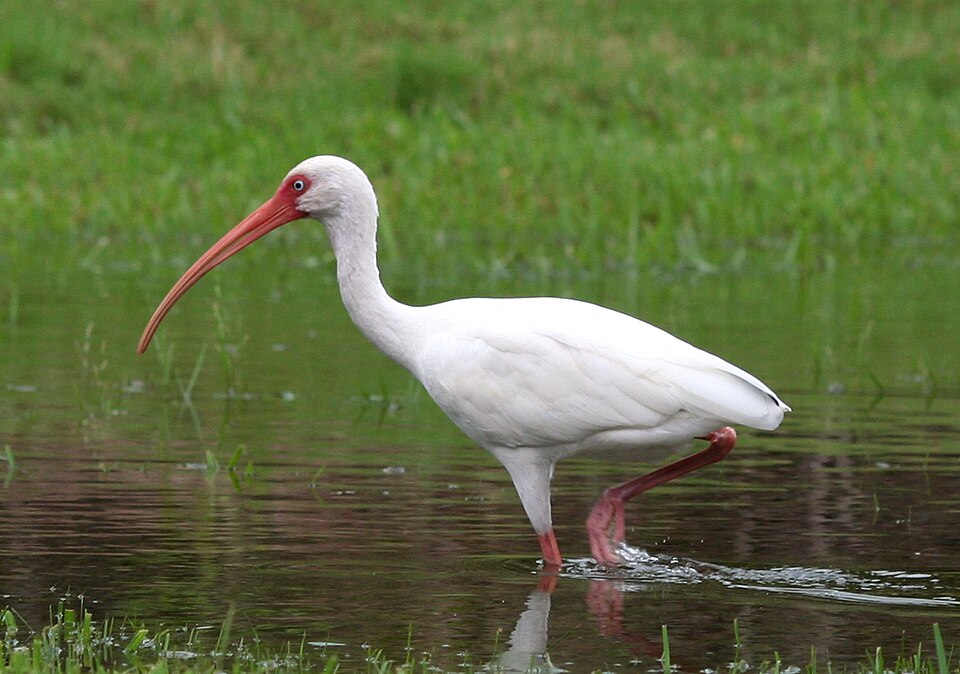
About the American White Ibis
The American white ibis (Eudocimus albus) is a species of bird in the ibis family, Threskiornithidae. It is found from the southern half of the US East Coast (from southern New Jersey to Georgia), along the Gulf Coast states (Florida, Alabama, Mississippi, Louisiana and Texas) and south through most of the Caribbean coastal regions of Central America. This particular ibis species is a medium-sized wading bird, possessing an overall white plumage with black wing-tips (usually only visible in flight), and having the typical downward-curving bill of the ibises, though of a bright red-orange color, the same hue as its long legs. Males are larger and have longer bills than females. The breeding range runs along the Gulf and Atlantic Coast, and the coasts of Mexico and Central America. Outside the breeding period, the range extends further inland in North America and also includes the Caribbean. It is also found along the northwestern South American coastline in Colombia and Venezuela. Populations in central Venezuela overlap and interbreed with the scarlet ibis. The two have been classified by some authorities as a single species.
No audio on this page yet
We only publish recordings we may use commercially, because this site is supported by ads. xeno-canto lists 71 recordings for this species: 5 CC BY-NC-SA · 1 CC BY-NC-ND. None of them permits commercial use, so there is no player here — the page is kept as a profile so the bird is not missing from the guide.
As soon as someone uploads a freely licensed recording, we mirror it and the player appears here.
Listed as recorded in Costa Rica, Ecuador, Guatemala, Mexico in the xeno-canto catalogue.
Other birds you can hear here
- American KestrelFalco sparveriusrecording
- American RedstartSetophaga ruticillarecording
- American Yellow WarblerSetophaga aestivarecording
- Band-backed WrenCampylorhynchus zonatusrecording
- Barred AntshrikeThamnophilus doliatusrecording
- Barred Forest FalconMicrastur ruficollisrecording
These are the birds recorded alongside it, not close relatives — the site holds no other member of its genus or family yet.