Hudsonian Whimbrel (Numenius hudsonicus)
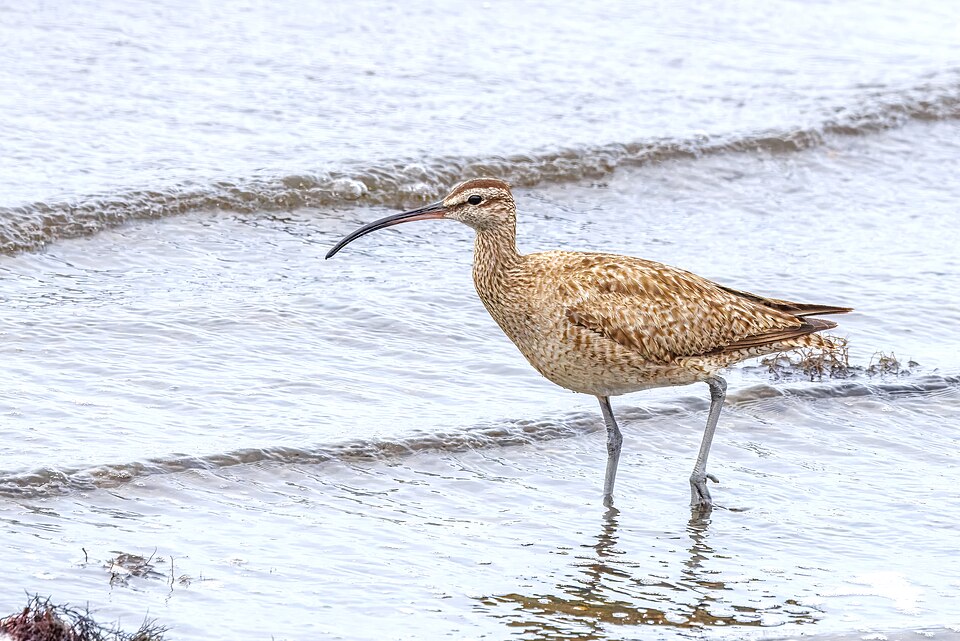
About the Hudsonian Whimbrel
The Hudsonian whimbrel or Hudsonian curlew (Numenius hudsonicus) is a wader in the large family Scolopacidae. It is one of the most widespread of the curlews, breeding across much of subarctic North America. Scientific Classification. This species and the Eurasian whimbrel were split in 2019 based on genetic and morphological differences and separate breeding ranges. Two subspecies are recognized: Numenius hudsonicus rufiventris – Vigors, 1829: breeds in Alaska and northwestern Canada Numenius hudsonicus hudsonicus – Latham, 1790: (Hudsonian curlew) breeds in Hudson Bay area to northeastern CanadaDescription.
Ecology and behavior
As a member of Scolopacidae, this bird is associated with mudflats, beaches, tundra, marshes and wet grass. It generally feeds by probing mud and soil for invertebrates. These habits determine where the bird is easiest to observe and explain why a recording often gives the first clue to its presence. Recorded examples on this site are linked to Canada. Local vegetation and weather can change the impression of the voice, but field identification still depends on the same evidence: the perch, surrounding cover and behavior of the calling bird.What to listen for
Flight notes are often high and clear; display songs may pulse or buzz. The available recordings are labeled as call. On the first listen, follow repetition and phrase length. On the second, decide whether the tone is clear, buzzy, burry, harsh, rounded or thin. On the third, trace pitch direction and the gaps between phrases. A strong field note describes the complete sound before naming the species. Note whether the bird stays hidden or uses an exposed perch, whether phrases accelerate, and whether the voice belongs to a boundary between two habitats. Those details make the recording useful during a real encounter. Replaying the recording after a short break also helps; familiar rhythm is easier to recognize than an isolated note. Compare the recording with the habitat immediately around you: the same phrase heard from dense cover, an exposed branch or an open edge can point toward different behavior. Returning to the phrase after a short pause makes the rhythm easier to remember and helps transfer the recording to field use.A field note on this voice
Listening context
The recordings shown here come from Canada. Because exact recording dates are not available for this conservative note, it is best not to treat any month or season as guaranteed. Local weather, latitude, habitat and breeding cycles can all change when a bird is most vocal. Use the region as a starting point, then look for supporting evidence in the field. Habitat, perch height, light conditions and observed behavior often provide more reliable context than a broad seasonal guess.
Time of day
The exact recording time is not available for this sample. Early morning is often a productive time to listen because many birds sing more regularly then and sound may carry well, but that is a general observation rather than a rule for this species. Birds may also vocalize later while feeding, moving through cover, interacting with nearby individuals or responding to disturbance. Listen for the same kinds of sounds at different times and compare the surrounding behavior.
What this vocalization may suggest
This page contains call. Songs are often longer, more structured and more repetitive than short calls. A clear phrase repeated at regular intervals can be associated with breeding activity or the defense of space, although the exact meaning should be confirmed by observation. Shorter or more abrupt notes may accompany movement, alertness or contact between birds. Changes in pace, volume or tone can sometimes reflect heightened interaction, while an evenly spaced delivery may simply be routine.
Understanding pitch
High notes do not automatically indicate courtship, and low notes do not necessarily signal alarm. Pitch works alongside rhythm, repetition, volume and tone. A high, clear phrase may be a territorial song, while high, irregular notes might suggest agitation; some low, soft sounds may simply help birds stay in contact. Rather than focusing on pitch alone, observe what the bird is doing before and after the sound. The most useful field note combines the voice with place, habitat, time and behavior.
Editor's note
These interpretations are intended as listening guidance based on the available recordings and context, not as proof of an individual bird's intent. When exact dates or times are unavailable, this note deliberately avoids claiming them. Strong observations record the date and time, habitat, perch height, weather and behavior before and after the vocalization.
A real field recording of the Hudsonian Whimbrel. Press play and focus on the rhythm and pitch of each phrase.