New Holland Honeyeater (Phylidonyris novaehollandiae)
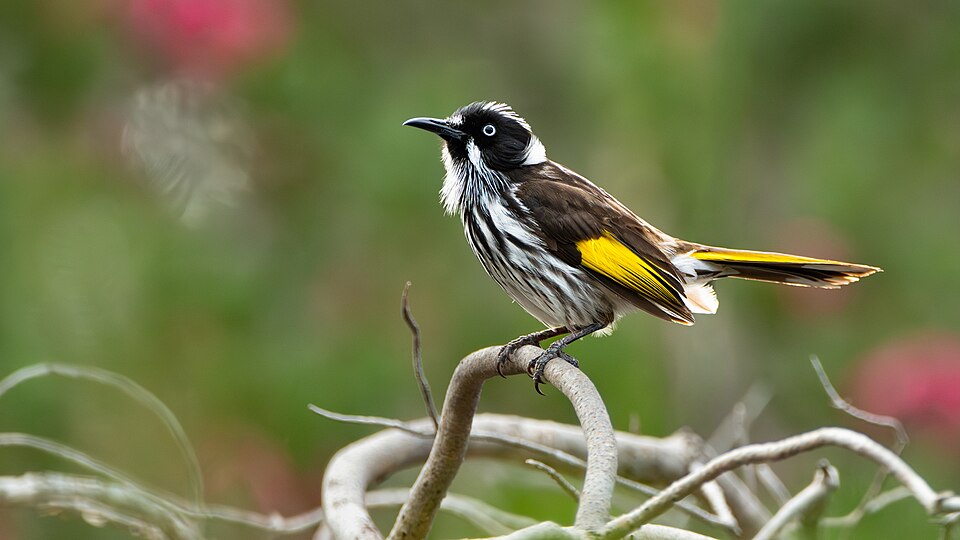
About the New Holland Honeyeater
The New Holland honeyeater (Phylidonyris novaehollandiae) is a honeyeater species found throughout southern Australia. It was among the first birds to be scientifically described in Australia, and was initially named Certhia novaehollandiae. The New Holland honeyeater was formally described in 1790 by the English ornithologist John Latham. He placed it with the tree creepers in the genus Certhia and coined the binomial name Certhia novaehollandiae. Latham based his account on the "New Holland Creeper" that had been described and illustrated by the Irish surgeon John White in his Journal of a Voyage to New South Wales. The New Holland honeyeater is now one of three species placed in the genus Phylidonyris that was introduced in 1830 by René Lesson. Five subspecies are recognised:
No audio on this page yet
We only publish recordings we may use commercially, because this site is supported by ads. xeno-canto lists 74 recordings for this species: 46 CC BY-NC-ND · 28 CC BY-NC-SA. None of them permits commercial use, so there is no player here — the page is kept as a profile so the bird is not missing from the guide.
As soon as someone uploads a freely licensed recording, we mirror it and the player appears here.
Listed as recorded in Australia in the xeno-canto catalogue.