Great Barbet (Psilopogon virens)
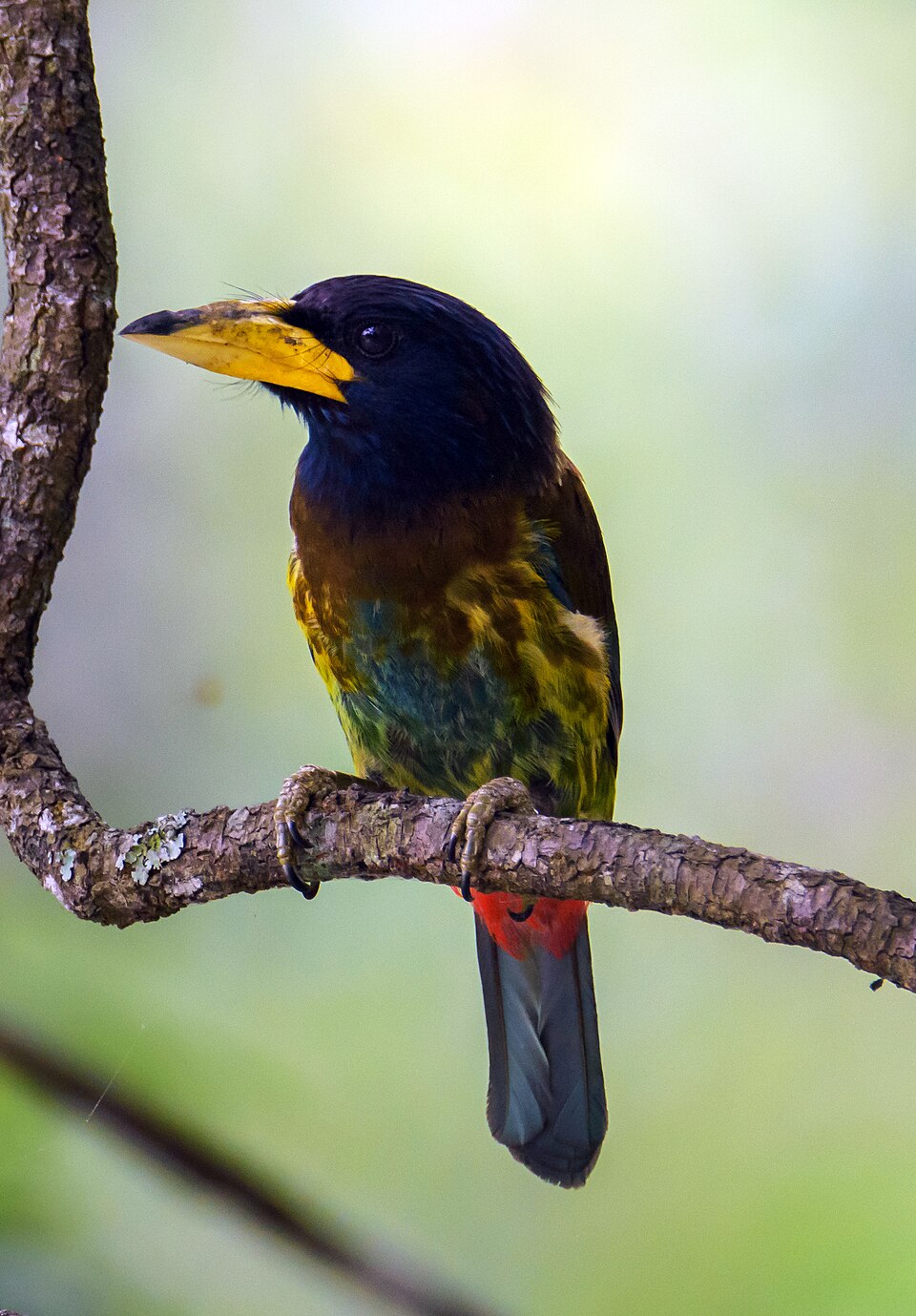
About the Great Barbet
The great barbet (Psilopogon virens) is an Asian barbet native to the Indian sub-continent and Southeast Asia, where it inhabits forests up to 3,000 m (9,800 ft) altitude. It has been listed as Least Concern on the IUCN Red List since 2004 because of its wide distribution. Bucco virens was the scientific name proposed by Pieter Boddaert in 1783 for a great barbet that had been described by Georges-Louis Leclerc, Comte de Buffon in 1781 based on a specimen collected in China. It was illustrated in a hand-coloured plate engraved by François-Nicolas Martinet. It was placed in the genus Megalaima proposed by George Robert Gray in 1842 who suggested to use this name instead of Bucco. In the 19th and 20th centuries, the following great barbet zoological specimens were described:
A real field recording of the Great Barbet. Press play and focus on the rhythm and pitch of each phrase.
Listen
Our streaming copies are mirrored from the original xeno-canto file and transcoded to 96 kbps mono — a modification, so we note it here; the licence for each recording is named in its credit below.
1 recording on this page · licensed CC BY ×1 · mirrored on this server, free for commercial reuse · recorded in China, India, Nepal, Thailand, Vietnam · xeno-canto lists 216 recordings for this species in total.
Similar species
- Black-banded BarbetPsilopogon javensisprofile
- Black-browed BarbetPsilopogon oortiprofile
- Blue-eared BarbetPsilopogon duvauceliiprofile
- Blue-throated BarbetPsilopogon asiaticusrecording
- Bornean BarbetPsilopogon eximiusprofile
- Brown-headed BarbetPsilopogon zeylanicusrecording
Species grouped by shared genus, family and range.