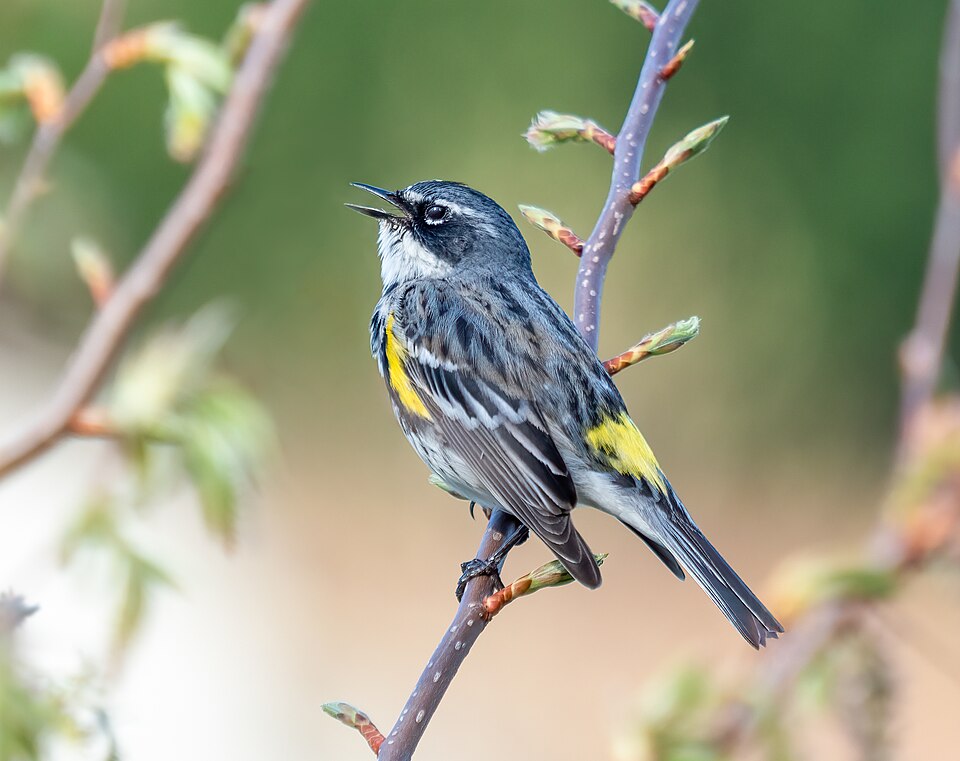
Myrtle Warbler (Setophaga coronata)
Also known asKronenwaldsänger · Mariquita-de-asa-amarela · 黃腰白喉林鶯 · キヅタアメリカムシクイ · Миртовый лесной певун · Geelstuitzanger · Bosquerola coronada · Lesňáček žlutokorunkatý · Myrtesanger · Keltaperäkerttuli
Listen
Our streaming copies are mirrored from the original xeno-canto file and transcoded to 96 kbps mono — a modification, so we note it here; the licence for each recording is named in its credit above.
3 recordings on this page · licensed CC BY-SA ×3 · mirrored on this server, free for commercial reuse · recorded in Canada, United States, Honduras, Mexico, United Kingdom · xeno-canto lists 513 recordings for this species in total.
A real field recording of the Myrtle Warbler. Press play and focus on the rhythm and pitch of each phrase.
About the Myrtle Warbler
The yellow-rumped warbler (Setophaga coronata) is a North American bird species that can be commonly observed all across the continent. Its extensive range connects both the Pacific and Atlantic coasts of the U.S. as well as Canada and Central America, with the population concentrated in the continent's northern reaches during the breeding season and migrating southwards to southern North and Central America in the winter. It generally prefers coniferous forests or mixed coniferous-deciduous forests as its breeding habitat, while during the winter it can be found inhabiting more open areas such as shrublands that offer food resources. The yellow-rumped warbler is primarily insectivorous, though the species eats fruit such as juniper berries, especially in winter.
Ecology and behavior
As a member of the Parulidae, this species is associated with deciduous woodland, thickets, canopy, marshes and forest edges. It typically feeds by insects, sometimes fruit or nectar outside breeding season. That combination of habitat and feeding behavior explains where the bird is easiest to find and why it may be heard more often than seen. Across its range, recorded examples are linked to Canada, United States. Local habitat can change the exact impression of the voice, but the useful field method stays the same: note the perch, surrounding vegetation, and whether the bird repeats one phrase or gives separate contact sounds.What to listen for
Many songs are thin, bright, buzzy or rapid; compare clear versus buzzy endings and count repetitions. The recordings on this page are labeled here as song, call. Compare each phrase in three passes. First follow the rhythm and repetition. Then judge whether the tone is clear, burry, buzzy, rounded or harsh. Finally notice the pitch direction and the spacing between statements. These three features are more reliable than trying to translate the sound into words alone. A useful field note should describe the whole phrase before naming the bird. For this species, write whether the sound stays level, rises or falls, how long each series lasts, and whether the bird seems exposed, hidden in cover, or associated with a particular edge between habitats. Those details make the recording transferable to a real outdoor encounter.A field note on this voice
When you are most likely to hear this voice
The recordings featured here were made in August, June, May. Those months may offer a useful seasonal clue, but vocal activity can vary widely across regions and years. Weather, latitude, food availability and local breeding cycles may all influence when a bird chooses to sing. Think of the timing as a starting point rather than a rule. The examples on this page come from recordings made in United States, Canada. In the field, behavior and habitat often provide stronger evidence than the calendar alone.
Time of day
The collection includes both morning and later-day recordings; the average time is around 11:00. Many birds are especially vocal in the early hours, when sound may carry well and singing can be a regular part of the morning. Birds may also vocalize later in the day while feeding, moving between perches, interacting with nearby individuals or responding to changes around them. Listening conditions can change how a sound is perceived. Returning to the same recording at different times and imagining the surrounding cover, light and weather can make the context easier to hear.
What this vocalization may suggest
This page contains a song rather than a simple call. Songs are often longer, more structured and more repetitive than short calls. A clear phrase repeated at regular intervals can be associated with breeding activity or the defense of space, although the exact context is best confirmed by observation. Shorter notes may accompany movement, alertness or contact with nearby birds. Faster, louder or harsher delivery can sometimes reflect heightened interaction, while an evenly spaced performance may simply be routine. Notice the surrounding behavior before deciding what the sound might mean.
Understanding pitch
High notes do not automatically indicate courtship, and low notes do not necessarily signal alarm. Pitch works alongside rhythm, repetition, volume and tone. A high, clear phrase may be a territorial song, while high, irregular notes might suggest agitation; some low, soft sounds may simply help birds stay in contact. Rather than focusing on pitch alone, observe what the bird is doing before and after the sound. The most useful field note combines the voice with place, time and behavior.
Editor's note
These interpretations are intended as listening guidance based on the available recordings and context, not as proof of an individual bird's intent. Strong observations note the date and time, habitat, perch height, weather and behavior before and after the vocalization.
Similar species
- American RedstartSetophaga ruticillarecording
- American Yellow WarblerSetophaga aestivarecording
- Black-throated Blue WarblerSetophaga caerulescensrecording
- Blackburnian WarblerSetophaga fuscarecording
- Cerulean WarblerSetophaga cerulearecording
- Chestnut-sided WarblerSetophaga pensylvanicarecording
- Golden-cheeked WarblerSetophaga chrysopariarecording
- Grace's WarblerSetophaga graciaerecording
- Hooded WarblerSetophaga citrinarecording
- Mangrove WarblerSetophaga petechiarecording
Species grouped by shared genus, family and range. Family: Parulidae.
More birds recorded in Canada
- MallardAnas platyrhynchosrecording
- Marsh WrenCistothorus palustrisrecording
- MerlinFalco columbariusrecording
- Mountain BluebirdSialia currucoidesrecording
- Mountain ChickadeePoecile gambelirecording
- Mourning DoveZenaida macrourarecording
- Mourning WarblerGeothlypis philadelphiarecording
- Mute SwanCygnus olorrecording
Every species xeno-canto lists for this country is on the full Canada list — 406 species, the ones with recordings marked ▶.