Long-tailed Paradise Whydah (Vidua paradisaea)
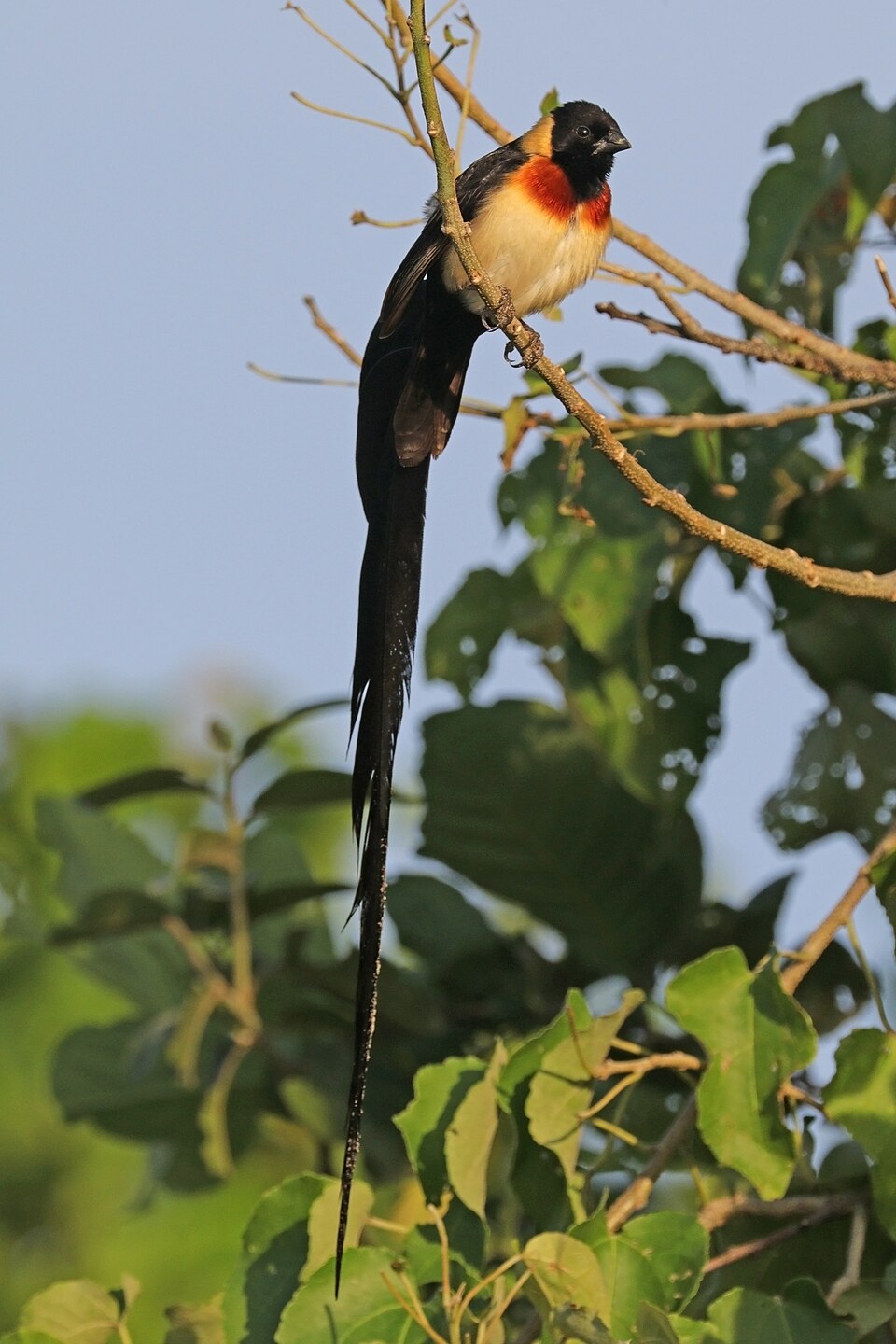
About the Long-tailed Paradise Whydah
The long-tailed paradise whydah or eastern paradise whydah (Vidua paradisaea) is a bird in the family Viduidae of the order Passeriformes. It is a small passerine with a short, stubby bill, found across eastern and southern Africa from Ethiopia south to South Africa and west to Angola. It is mostly granivorous, and feed on seeds that have ripened and fallen on the ground. The ability to distinguish between males and females is quite difficult unless it is breeding season. During this time, the males moult into breeding plumage where they have a distinctive long tail. This can be up to three times longer than its own body or even more. Males are able to mimic songs where females can use that to discover their mate. However, there are some cases where females don't use songs to choose their mate but they use either male characteristics like plumage or they can have a shortage of options with song mimicry. Paradise whydahs are brood parasites. They do not destroy the host eggs that are originally there, but lay their own eggs alogside in the other bird's nest. Overall, these whydahs are considered least concern, based on the IUCN Red List of threatened species.
No audio on this page yet
We only publish recordings we may use commercially, because this site is supported by ads. xeno-canto lists 8 recordings for this species: 2 CC BY-NC-SA · 1 CC BY-NC-ND. None of them permits commercial use, so there is no player here — the page is kept as a profile so the bird is not missing from the guide.
As soon as someone uploads a freely licensed recording, we mirror it and the player appears here.
Listed as recorded in Ethiopia, Namibia, South Africa in the xeno-canto catalogue.
Related species you can hear
- Village IndigobirdVidua chalybeatarecording
This species has no recording here yet — these relatives do, so you can hear what the family sounds like.