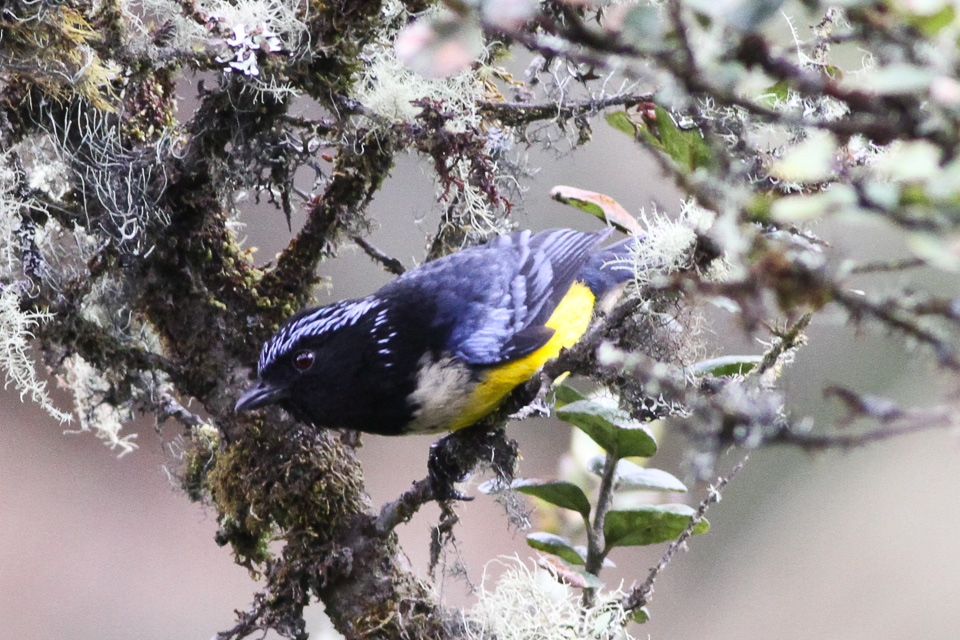
Buff-breasted Mountain Tanager (Dubusia taeniata)
Also known asSilberbrauen-Bergtangare · Tangara à poitrine fauve · ギンマユフウキンチョウ · فرخنده کوهستان سینهنخودی · Dubusia · Tàngara andina de pit pàl·lid · Tangara hnědoproužková · Sølvbrynet Bjergtangar · Bambutangara · Rimbryntanagar
Listen
Our streaming copies are mirrored from the original xeno-canto file and transcoded to 96 kbps mono — a modification, so we note it here; the licence for each recording is named in its credit above.
3 recordings on this page · licensed CC BY-SA ×3 · mirrored on this server, free for commercial reuse · recorded in Colombia, Ecuador, Peru, Venezuela · xeno-canto lists 138 recordings for this species in total.
A real field recording of the Buff-breasted Mountain Tanager. Press play and focus on the rhythm and pitch of each phrase.
About the Buff-breasted Mountain Tanager
The buff-banded mountain tanager (Dubusia taeniata), formerly known as the buff-breasted mountain tanager, is a species of Neotropical bird in the tanager family Thraupidae. It is found in Bolivia, Colombia, Ecuador, Peru, and Venezuela. Its natural habitat is subtropical or tropical moist montane forests. The buff-banded mountain tanager was formally described in 1840 by the French ornithologist Auguste Boissonneau from a specimen collected near Bogotá in Colombia. He coined the binomial name Tanagra taeniata. The specific epithet is the Latin word for a "head-band". This species is now placed in the genus Dubusia that was introduced in 1850 by the French naturalist Charles Lucien Bonaparte.
Ecology and behavior
As a member of the Thraupidae, this species is associated with Neotropical forest, edges, canopy, scrub and gardens. It typically feeds by fruit, insects, nectar and seeds, often in active pairs or flocks. That combination of habitat and feeding behavior explains where the bird is easiest to find and why it may be heard more often than seen. Across its range, recorded examples are linked to Colombia, Ecuador. Local habitat can change the exact impression of the voice, but the useful field method stays the same: note the perch, surrounding vegetation, and whether the bird repeats one phrase or gives separate contact sounds.What to listen for
Voices range from high chips to sharp, lisping or rhythmic songs; canopy behavior is often as useful as tone. The recordings on this page are labeled here as song, call. Compare each phrase in three passes. First follow the rhythm and repetition. Then judge whether the tone is clear, burry, buzzy, rounded or harsh. Finally notice the pitch direction and the spacing between statements. These three features are more reliable than trying to translate the sound into words alone. A useful field note should describe the whole phrase before naming the bird. For this species, write whether the sound stays level, rises or falls, how long each series lasts, and whether the bird seems exposed, hidden in cover, or associated with a particular edge between habitats. Those details make the recording transferable to a real outdoor encounter.A field note on this voice
When you are most likely to hear this voice
The recordings featured here were made in February, September. Those months may offer a useful seasonal clue, but vocal activity can vary widely across regions and years. Weather, latitude, food availability and local breeding cycles may all influence when a bird chooses to sing. Think of the timing as a starting point rather than a rule. The examples on this page come from recordings made in Ecuador, Colombia. In the field, behavior and habitat often provide stronger evidence than the calendar alone.
Time of day
The collection includes both morning and later-day recordings; the average time is around 09:00. Many birds are especially vocal in the early hours, when sound may carry well and singing can be a regular part of the morning. Birds may also vocalize later in the day while feeding, moving between perches, interacting with nearby individuals or responding to changes around them. Listening conditions can change how a sound is perceived. Returning to the same recording at different times and imagining the surrounding cover, light and weather can make the context easier to hear.
What this vocalization may suggest
This page contains a song rather than a simple call. Songs are often longer, more structured and more repetitive than short calls. A clear phrase repeated at regular intervals can be associated with breeding activity or the defense of space, although the exact context is best confirmed by observation. Shorter notes may accompany movement, alertness or contact with nearby birds. Faster, louder or harsher delivery can sometimes reflect heightened interaction, while an evenly spaced performance may simply be routine. Notice the surrounding behavior before deciding what the sound might mean.
Understanding pitch
High notes do not automatically indicate courtship, and low notes do not necessarily signal alarm. Pitch works alongside rhythm, repetition, volume and tone. A high, clear phrase may be a territorial song, while high, irregular notes might suggest agitation; some low, soft sounds may simply help birds stay in contact. Rather than focusing on pitch alone, observe what the bird is doing before and after the sound. The most useful field note combines the voice with place, time and behavior.
Editor's note
These interpretations are intended as listening guidance based on the available recordings and context, not as proof of an individual bird's intent. Strong observations note the date and time, habitat, perch height, weather and behavior before and after the vocalization.
Similar species
- Chestnut-bellied Mountain TanagerDubusia castaneoventrisprofile
- Ash-breasted Sierra FinchGeospizopsis plebejusrecording
- BananaquitCoereba flaveolarecording
- Bay-headed TanagerTangara gyrolarecording
- Beryl-spangled TanagerTangara nigroviridisrecording
- Black FlowerpiercerDiglossa humeralisrecording
- Black-and-white SeedeaterSporophila luctuosarecording
- Black-and-white TanagerConothraupis speculigerarecording
- Black-billed Seed FinchSporophila atrirostrisrecording
- Black-capped HemispingusKleinothraupis atropileusrecording
Species grouped by shared genus, family and range. Family: Thraupidae.
More birds recorded in Colombia
- Yellow-throated VireoVireo flavifronsprofile
- Yellow-tufted DacnisDacnis egregiaprofile
- Yellow-vented WoodpeckerVeniliornis dignusprofile
- Yellowish PipitAnthus lutescensprofile
- Zimmer's WoodcreeperDendroplex kieneriiprofile
- Acadian FlycatcherEmpidonax virescensrecording
- Acorn WoodpeckerMelanerpes formicivorusrecording
- Agile Tit-TyrantUromyias agilisrecording
Every species xeno-canto lists for this country is on the full Colombia list — 1,573 species, the ones with recordings marked ▶.